Why Blocking Changes a Finished Knit More Than You Expect
Quick Answer: Blocking works because water temporarily breaks the hydrogen bonds holding fibres in shape, letting them relax and reset in a new configuration as they dry. Protein fibres like wool change dramatically and hold it; plant fibres change less and hold it poorly; acrylic does not change at all without heat.
You finish a sweater. The fabric is uneven, the edges curl, the lace looks like a rumour, and the whole thing seems slightly wrong.
You soak it, pin it out, and come back the next day to something that looks like it was made by someone more competent.
Nothing about the knitting changed. Here is what did.

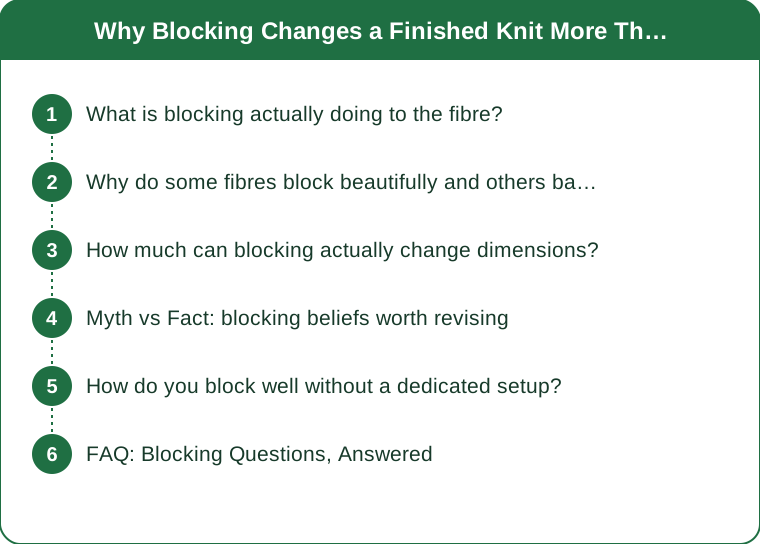
What is blocking actually doing to the fibre?
Breaking and remaking bonds, at a level you cannot see.
Wool fibres are made of keratin, a protein whose shape is maintained partly by hydrogen bonds between adjacent protein chains. Water disrupts those bonds temporarily. While the fibre is wet, the chains can slide relative to each other and settle into new positions. As the water evaporates, the bonds reform — in whatever configuration you have pinned the fabric into.
This is the same principle behind setting hair with water, and the analogy is close enough to be genuinely useful. It also explains why the effect is semi-permanent rather than permanent: reintroduce water, and the bonds break again.
There is a second, more mundane mechanism running alongside it. Yarn arrives under tension from spinning and winding, and knitting adds more. Wetting lets the yarn relax and lets the stitches find their natural size and spacing. A large part of what you see as improved evenness is simply tension escaping, which is why blocking makes uneven knitting look considerably more even without you having done anything to the stitches.
Why do some fibres block beautifully and others barely at all?
Because the chemistry is different, and it decides everything.
Protein fibres — wool, alpaca, mohair, cashmere, silk. These have the hydrogen bond structure described above, and they block superbly. Wool is the best of them, with excellent memory and dramatic transformation of lace and cables. This is why traditional patterns assume blocking; they were designed around a fibre that responds to it.
Plant fibres — cotton, linen, hemp. These are cellulose, with a different and more rigid structure. They do block, and linen in particular improves noticeably with wet blocking and softens with each wash, but they hold the new shape less enthusiastically and tend to relax back toward their own preference over time. Cotton also grows lengthwise under its own weight, which blocking cannot fix.
Synthetics — acrylic, nylon, polyester. Wet blocking essentially does nothing, because there are no hydrogen bonds to break. Acrylic responds only to heat, which physically deforms the plastic — this is steam or killing acrylic, and it is genuinely permanent because you have melted the shape in. It also removes the fabric’s bounce entirely, which is sometimes what you want and often not.
Blends behave according to their dominant fibre, roughly proportionally. A 70 percent wool blend blocks nearly as well as pure wool; a 30 percent wool blend mostly does not.
How much can blocking actually change dimensions?
More than beginners expect and less than desperate knitters hope.
For a plain stockinette wool fabric, gaining or losing 5 to 10 percent in a dimension is comfortable and stable. Lace is the outlier — an aggressively blocked lace shawl can open up by 30 to 50 percent or more, because the yarnover holes are being pulled from closed to open rather than the fibre being stretched.
What blocking cannot do is rescue a garment that is genuinely the wrong size. Stretching a sweater 15 percent wider makes it correspondingly shorter and thinner, and it will migrate back toward its resting shape with wear and gravity. A sweater blocked well beyond its natural gauge is a temporary solution that reappears as a problem within a few wears.
This is the argument for the blocked gauge swatch, tedious as it is. Your unblocked gauge tells you almost nothing about the finished garment, and the difference between the two is frequently large enough to change a size.

Myth vs Fact: blocking beliefs worth revising
Myth: Blocking is optional for plain projects. Fact: It is optional for the appearance of some plain projects and essential for all seaming. Pieces that have been blocked flat align at the edges; pieces straight off the needles curl and lie at slightly different lengths, which is why the seams look amateurish.
Myth: Steam blocking is a faster version of wet blocking. Fact: It is a different, gentler intervention. Steam introduces less water and produces a less thorough reset, which is fine for a light adjustment and inadequate for opening lace. Full wet blocking is the stronger tool.
Myth: You should not block superwash wool. Fact: You absolutely should, and carefully. Superwash has had its scales removed or coated, which means it has less structural memory and tends to grow and stay grown. Block it to size rather than beyond, and dry it flat rather than hanging.
Myth: Once blocked, always blocked. Fact: Every wash resets it. Blocking is a step in the care routine, not a one-time finishing event, which is why it is worth keeping the mats accessible rather than at the back of a cupboard.
Myth: More pins means better blocking. Fact: Even tension means better blocking. Densely placed pins that pull unevenly produce a scalloped edge you then have to live with. Blocking wires exist precisely to distribute the tension along an edge.
How do you block well without a dedicated setup?
The equipment matters less than the method.
The soak. Lukewarm water, a little wool wash, 20 minutes. Not hot, and no agitation — heat plus movement plus wool is how felting happens. Lift the piece supporting its weight rather than letting it hang.
Removing water. Press, never wring. Roll the piece in a towel and press down on the roll, or use a spin cycle with no water if your machine allows it, which is remarkably effective and much faster than towels.
The surface. Interlocking foam mats are ideal, a spare bed with towels works, and the floor with a sheet works. The requirement is that it can take pins and can be left alone for a day.
Pinning. Measure rather than eyeball, work from the centre outward, and pin the piece to the dimensions the pattern specifies rather than to the size you wish it were. Blocking wires along straight edges eliminate scalloping entirely and are the single best purchase in this whole category.
Drying. Room temperature, decent air movement, no direct sun or radiator. A fan pointed across the room roughly halves the time. Wool is dry when it feels dry and then some — the core holds moisture longer than the surface suggests, and unpinning early loses most of the effect.
Twenty-four hours is typical. Bulky wool can take two days. It is the least interesting part of the process and the part that decides the result.
FAQ: Blocking Questions, Answered
Do I need to block a gauge swatch?
Yes, if you intend the garment to fit. Unblocked gauge routinely differs from blocked gauge by enough to shift a garment a full size, and the swatch is the cheapest possible place to discover that.
Can I re-block something that has gone out of shape?
Yes, and this is one of blocking’s underrated uses. A sweater that has stretched at the cuffs or grown at the hem generally returns with a fresh soak and a careful pinning to its correct dimensions.
Is it worth blocking socks?
Cosmetically it helps for photographs and gifts; functionally it does very little, since socks are blocked by feet within an hour of wearing. Sock blockers are for presentation rather than performance.
What if my piece smells odd after blocking?
Wet wool has a distinctive smell that fades as it dries completely. If it persists after full drying, the piece was probably unpinned before the core was dry, and another day of air will usually sort it.
TL;DR:
- Water breaks the hydrogen bonds holding fibre shape, and they reform in whatever position you dry the piece in.
- Protein fibres block dramatically and hold it; plant fibres block modestly; acrylic needs heat and the change is permanent.
- Expect 5 to 10 percent adjustment on plain fabric and far more on lace, but do not use blocking to fix a genuinely wrong size.
- Block your swatch, use wires on straight edges, and let it dry completely before unpinning.
If you have never blocked a plain stockinette piece because it seemed unnecessary, block the next one and lay it beside an unblocked swatch. The comparison tends to end the debate permanently.
Keep Reading
This article is for general informational and styling purposes only. Fit, sizing, and product availability may vary.