Why Your Knitting Speeds Up When the Pattern Gets Harder
Quick Answer: Plain rows are slow because they are boring enough to let your mind wander, and a wandering mind means micro-pauses, lost count and re-checks. A demanding chart occupies your working memory fully, which produces something close to a flow state: fewer interruptions, steadier tension, and rhythm that does not stall. The complexity is not making you faster, the absence of distraction is. Which is why the same stockinette body knits quickly during a good podcast and glacially in silence.
The cable panel you dreaded took an evening. The plain sleeve you thought would fly has been on the needles for eleven days.
This is not a character flaw. It is a well-documented feature of how attention works with repetitive tasks.
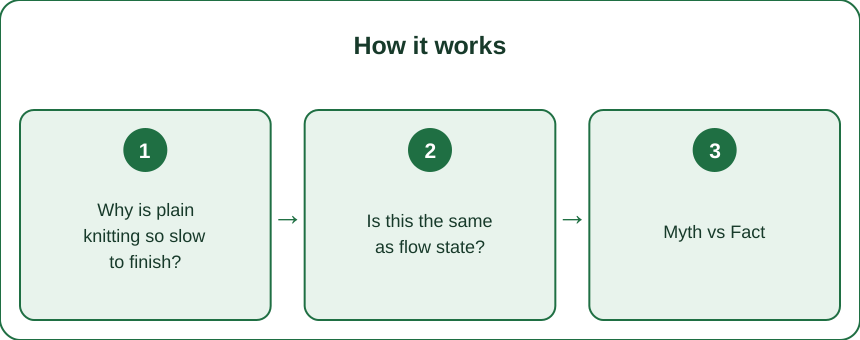
Why is plain knitting so slow to finish?
Repetitive tasks have a demand problem. They require just enough attention that you cannot fully disengage, but not enough to hold your interest. Psychologists studying vigilance have documented this for decades, and it is the least comfortable place for a brain to sit.
So you drift. And drift produces exactly the small costs that add up: you glance at your phone, you lose your place in the row, you notice you have twisted a stitch four rows back, you put the work down to think about something else.
Each interruption costs far more than the seconds it takes. Re-establishing rhythm after a pause is the expensive part, not the pause itself.
A cable chart never gives you the opening. It demands your attention continuously, so it never has to be regained.
Is this the same as flow state?
It is close, and the conditions line up unusually well.
Flow tends to appear when three things are true: the task has clear immediate goals, it gives instant feedback, and the challenge roughly matches your skill. A lace repeat delivers all three. You know exactly what the next four stitches are, you can see immediately if you got them wrong, and the difficulty sits at the edge of comfortable.
Stockinette gives you the first, fails the second, and badly fails the third. The challenge sits far below your skill, which is the classic recipe for boredom rather than flow.
The result is that hard knitting feels shorter than it was and easy knitting feels longer. Time perception compresses under absorbed attention. Your hands may actually be slower on the cable row and the evening still ends with more of it done.
Myth vs Fact: knitting speed
Myth: Faster knitters have faster hands. Fact: At the same technique, hand speed between an intermediate and an advanced knitter differs far less than uninterrupted time does. Consistency beats speed.
Myth: Complex patterns are less relaxing. Fact: Many knitters report the opposite. Full absorption is more restful than half-attention, which leaves room for rumination.
Myth: You should finish the boring parts first to get them out of the way. Fact: This is how projects get abandoned. The boring section is where motivation is lowest, and front-loading it means the whole project sits at its least rewarding point.
Myth: Audiobooks slow you down. Fact: For plain knitting they usually speed you up considerably, because they occupy the attention that would otherwise wander. For charted work they compete for the same resources and slow you down.

How do I make plain sections behave like complex ones?
The goal is to add structure or occupation without adding real difficulty.
-
Pair by demand, not by preference. Charted rows want silence or instrumental music. Plain rows want an audiobook, a podcast or a show you have already seen.
-
Add artificial checkpoints. Place a removable marker every 20 rows. You get feedback and a small completion hit at regular intervals, which is what the plain section was missing.
-
Alternate projects deliberately. Keep one charted project and one plain project going, and switch by mood rather than guilt. This is not lack of discipline, it is matching task demand to your available attention.
-
Set a row target, not a time target. Twelve rows finishes. Thirty minutes drifts.
-
Do the plain rows early in the day if you can. Vigilance drops through the evening, and the boring section suffers most from a tired brain.
The checkpoint trick is the one most people dismiss and then find works immediately.
Does this change my tension?
Yes, and usually in the direction people do not expect.
Absorbed knitting tends to produce more even tension because your hands settle into a single consistent motion and stay there. Distracted knitting produces micro-variation, tighter after a stressful moment in the podcast, looser as you relax again.
That is why some knitters find a cable panel blocks beautifully while a stockinette body shows subtle horizontal banding. The banding is a record of your attention across eleven evenings.
If your plain sections block unevenly, the fix is less about technique and more about knitting them in fewer, longer, more consistent sessions rather than many short scattered ones.
FAQ: Knitting Rhythm Questions, Answered
Should I just avoid plain patterns then?
No, but choose them knowingly. A plain project is a good companion project, not a good sole project. Its slowness is structural, not a failure of will.
Why do I knit faster near the end of a project?
The goal becomes visible and immediate, which restores the clear-feedback condition that the middle of a project lacks. It is the same mechanism running in your favour.
Does this apply to crochet too?
Yes, and often more strongly, since crochet stitches are individually more distinct and give slightly richer feedback per stitch.
Is knitting in silence better for mindfulness?
For charted work, generally yes. For plain rows, silence often means rumination rather than presence, which is the opposite of what people are after.
TL;DR:
- Plain rows are slow because they invite a wandering mind, and every interruption costs more than the pause itself.
- Charted work meets the conditions for flow: clear goals, instant feedback, matched challenge.
- Match input to demand: audio for plain rows, silence for charts.
- Add markers every 20 rows to give a boring section the feedback it lacks.
You are not bad at plain knitting. You are a normally-attentioned human doing a task that was designed, quite by accident, to be hard to stay with. Give it a structure and it stops taking eleven days.
Keep Reading
This article is for general informational and styling purposes only. Fit, sizing, and product availability may vary.