Why Your Knitting Gets Harder as the Evenings Get Darker
Quick Answer: Knitting is a fine visual task performed at close range, and the light most people have in the evening is a fraction of what daylight provided. Low, warm, single-source lighting reduces contrast, forces your eyes to work harder, and produces exactly the symptoms people blame on the pattern — tighter tension, more lost counts, and fatigue after twenty minutes instead of an hour.
A better lamp fixes more of this than a better pattern will.
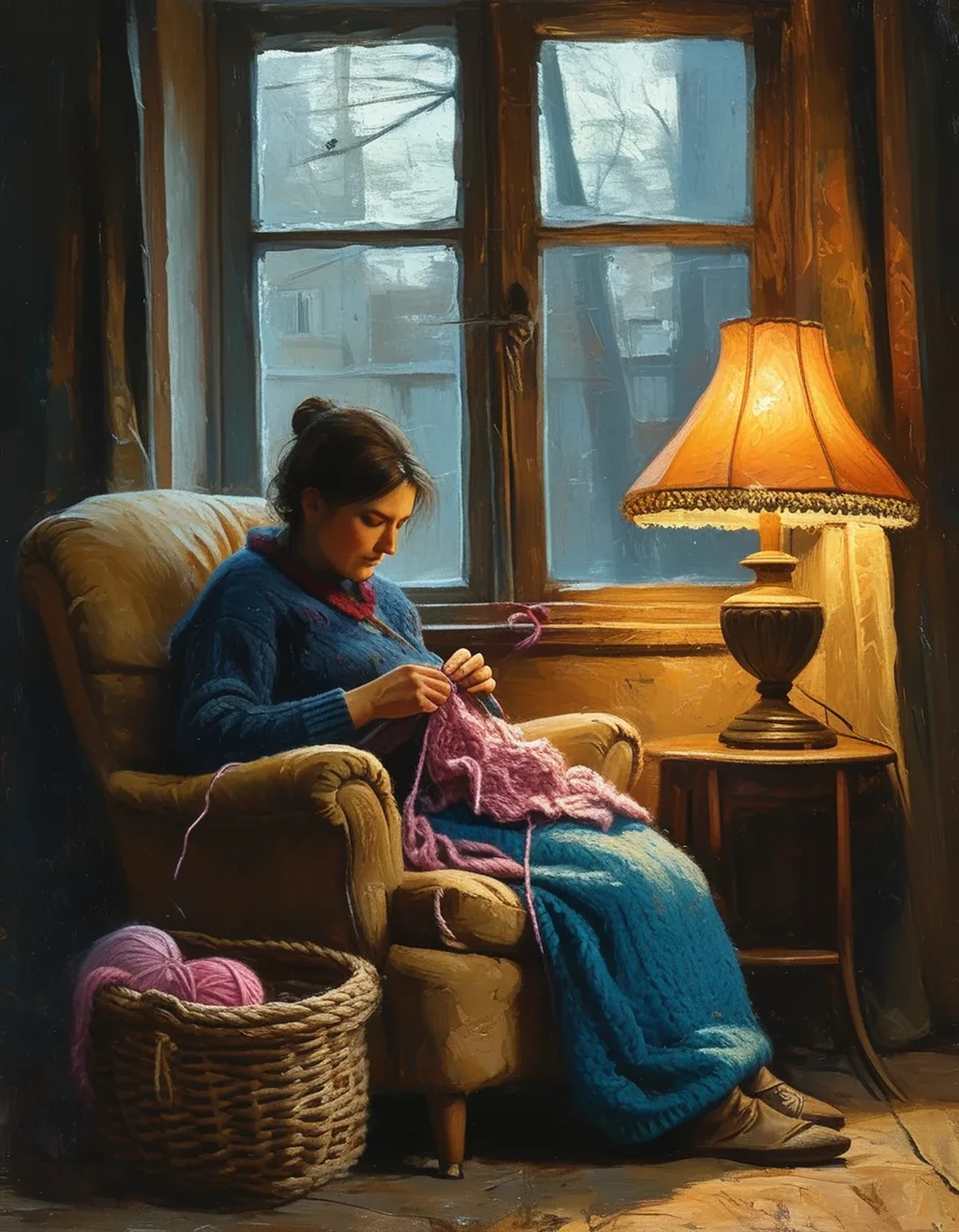
Why does light affect tension and not just visibility?
Straining to see makes you grip harder. Visual effort produces general muscular tension, and the hands are where knitters express it. Tension that tightens across an evening is a very common pattern and it tracks the light more often than the mood.
You bring the work closer. In poor light people unconsciously raise the knitting toward their face, which shortens the working distance, closes the shoulders and changes the angle of the wrists — all of which alter how the yarn feeds.
Contrast is the real problem, not brightness alone. Dark yarn on a dark lap in warm light gives your eyes almost nothing to work with. The same yarn on a light towel across your knees becomes dramatically easier to read.
Colour temperature changes what you can distinguish. Very warm bulbs flatten the difference between navy, black and dark charcoal, which is why some yarns become nearly unworkable at night.
And your eyes are already tired by evening. The accommodation system that focuses at close range has been working all day, and it is measurably less efficient at nine o’clock than at nine in the morning.
What lighting actually helps?
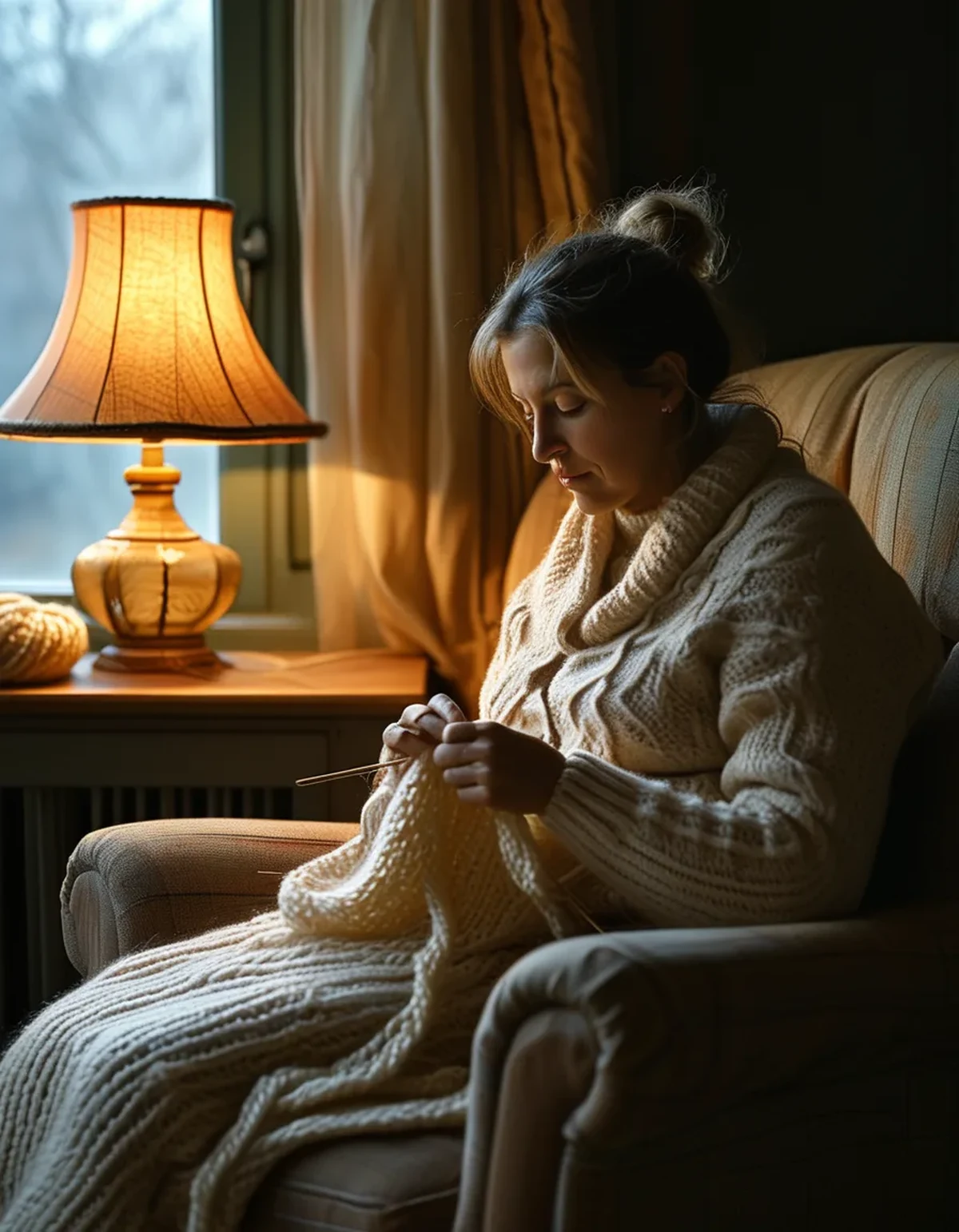
Get the light beside and slightly behind your shoulder, angled onto the work rather than into your eyes. Overhead ceiling light puts your own hands in shadow, which is the single most common lighting mistake.
Aim for a cooler bulb than the rest of the room. Something in the 4000 to 5000 kelvin range renders colour far better for detailed work than a 2700K warm bulb, even though the warm one is nicer to sit in.
Two sources beat one. A general room light plus a task lamp removes the harsh pool-of-light effect that makes your eyes constantly readjust between the work and the room.
Brightness matters and so does the beam. A task lamp you can position is worth more than a brighter fixed one, because the angle is doing most of the work.
Use a contrasting lap cloth. A light towel under dark yarn, or a dark one under pale yarn, is the cheapest improvement available and it makes an immediate difference to counting.
And consider where you sit. People keep their summer knitting chair into November, when the good light has moved to a different part of the room entirely.
What else changes at this time of year?
Projects get bigger. Autumn is when people start jumpers and blankets, so the work is heavier, the rows are longer, and the fabric bunches in your lap where it did not in July.
Yarn changes with the season. Wool and heavier fibres behave differently from summer cotton — more grip, more elasticity, and a different tension entirely for the same hands.
Heating changes your hands. Dry indoor air affects skin, and drier fingers grip yarn differently. Cold hands early in the evening then warm hands later produces measurable tension drift within a single session.
You knit at different times. Summer knitting happens in daylight at odd hours; autumn knitting concentrates into the evening, which is both the darkest and the most tired part of your day.
And the clocks change. The abrupt shift in when it gets dark disrupts routines that were working, and knitting habits are as vulnerable to that as sleep is.
What Nobody Tells You About Knitting and Your Eyes
Near work does not damage your eyes, but it does fatigue them. The discomfort, dryness and difficulty refocusing after a long session are real and temporary rather than harmful.
Blinking drops dramatically during concentrated work. Anything requiring sustained focus reduces blink rate substantially, which is why eyes feel dry and gritty after an hour of a complex chart.
The 20-20-20 idea applies here too. Every twenty minutes, look at something roughly twenty feet away for twenty seconds. It resets the focusing muscles and it takes almost no time.
Reading glasses and knitting distance are not the same. Standard reading prescriptions are set for a book at about 40cm; knitting frequently happens closer or at a different angle, which is worth mentioning at your next eye test.
Varifocals are genuinely awkward for knitting because the near section sits at the bottom of the lens, so you end up tilting your head back to see work in your lap. Many knitters end up with a dedicated single-vision pair, and it is one of the most common quiet fixes in knitting groups.
Magnifier lamps are underrated for charted work, and they solve light and magnification together.
And if the difficulty is sudden rather than seasonal, get your eyes tested. A change that arrives over one or two weeks rather than gradually with the season is worth checking rather than working around.
One last thing: the pattern is probably not harder than you remember. Rereading a chart in good light on a Saturday morning after struggling with it all week is a reliably humbling experience.
FAQ: Low Light Knitting Questions, Answered
Is a daylight lamp worth the money?
For anyone knitting several evenings a week, generally yes. The colour rendering and the positionable arm together do more than a brighter ordinary bulb would.
Why is dark yarn so much harder?
Because knitting is read by shadow — you identify stitches by the small shadows between them. Dark yarn produces almost no visible shadow in low light, so the structure disappears.
Should I just switch to lighter yarn in winter?
It genuinely helps, and it is a reasonable seasonal strategy. Save dark projects for daylight hours and keep a pale one for evenings.
Does knitting in poor light ruin your eyes?
No. It causes fatigue and discomfort, not damage. That is still a good reason to fix the lighting.
TL;DR:
- Visual strain makes you grip harder, which is why tension tightens as the evening goes on.
- Put a positionable lamp beside and slightly behind your shoulder, cooler than the room lighting.
- A contrasting lap cloth under the work is the cheapest large improvement available.
- Look twenty feet away for twenty seconds every twenty minutes, and blink deliberately.
- Save dark yarn for daylight; keep a pale project for evenings.
The pattern did not get harder. The light left.
Keep Reading
This article is for general informational and styling purposes only. Fit, sizing, and product availability may vary.