Knitter's Hands: Ergonomics for Marathon Stitching Sessions
Quick Answer: Knitting hand pain is almost always a grip and duration problem, not a technique problem. Hold the needles rather than gripping them, stop every 20 minutes for a 45-second stretch, support your elbows and raise the work on a cushion, and switch to bamboo needles if your hands ache. Tingling, numbness or night pain means a clinician, not a different cast-on.
Knitting’s dirty secret: the world’s most relaxing hobby can hand you claw-hands after a three-episode binge.
Repetitive craft is repetitive strain with much better vibes. The fix isn’t knitting less — it’s knitting with a setup that doesn’t quietly invoice your tendons.
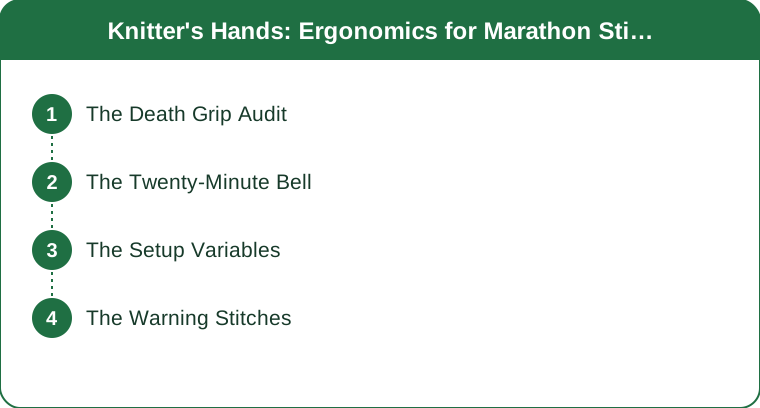
Why do my hands hurt after knitting?
Three causes, in order of how often they’re the real one.
Grip tension. New knitters strangle their needles, and so do experienced knitters working a tricky pattern or an anxious evening. Tension anxiety flows straight into the hands.
The cue that fixes it: the needles should feel HELD, not gripped. If your knuckles are white, the scarf is not in danger — but your tendons are taking notes. Loose hands also knit faster, which is the rare case where the healthy option is also the productive one.
Duration without breaks. Two uninterrupted hours in the same position is the problem, not knitting itself. Muscles held in a static position fatigue and stop supporting the joints properly.
Setup. Unsupported elbows, work held too low, poor light. All three make you hunch, and hunching changes the load angle on everything downstream.
How often should you take breaks while knitting?
Every 20 minutes or so — roughly one act of an episode. The break costs about 45 seconds:
- Needles down. Actually put them down; hovering doesn’t count.
- Fists to starfish, 5 times. Squeeze, then spread the fingers wide.
- Wrist circles, 5 each direction.
- Shoulder drop and roll, 3 times back.
- Look at something 20 feet away for 10 seconds while you’re at it — your eyes have been at 18 inches for 20 minutes too.
Marathon sessions are earned in installments. Forty-five seconds every twenty minutes costs you about 6 minutes across a three-hour session and prevents the claw entirely.
What’s the best setup for long knitting sessions?
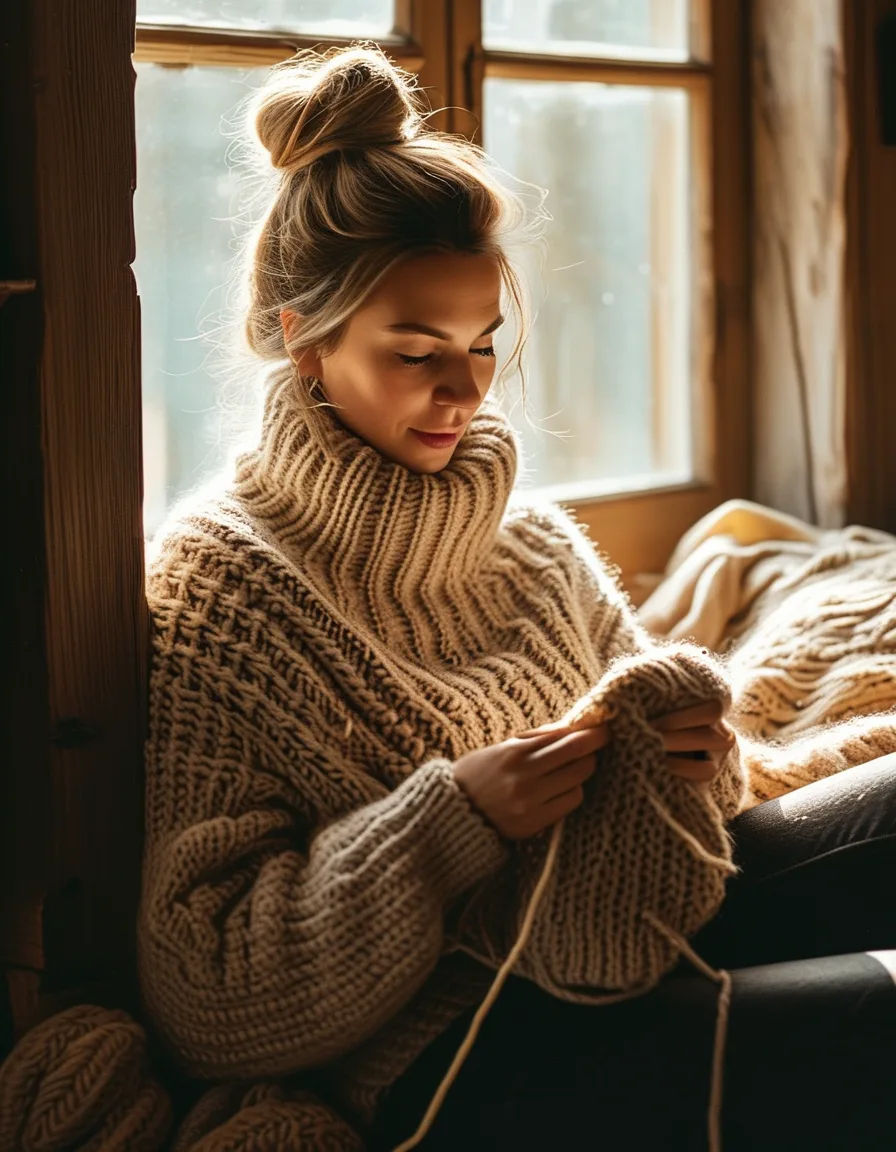
Support your elbows. An armchair with arms beats a backless stool by a wide margin. Unsupported arms mean your shoulders carry the weight for hours, and shoulder fatigue travels straight down to the hands.
Raise the work. A cushion or a folded blanket in your lap brings the knitting up 4 to 6 inches. Hunching over low work is the neck’s primary complaint about this hobby, and neck tension refers pain into the arms.
Get good light. Squinting creates forward head posture, which loads the neck, which loads the shoulders. A decent task light beside your chair is a hand-health purchase disguised as a lamp.
Choose kinder needles. Bamboo and wood are lighter, warmer and grippier than metal — the grip means you can hold them more loosely without the stitches sliding. For achy hands, this swap alone often makes a noticeable difference.
Consider needle style. Circular needles distribute the weight of a heavy project across your lap rather than hanging it off your wrists. For large blankets or garments, this matters a lot more than people expect.
Watch the yarn weight too. A dense, tight gauge in fine yarn requires more force per stitch than a chunky yarn on large needles. If your hands are complaining, a bulky project is a legitimate recovery plan.
What Nobody Tells You About Craft Ergonomics
- The way you sit matters more than the way you knit. Most people troubleshoot their stitch technique when the actual culprit is a low, unsupported chair.
- Anxiety knitting is tighter knitting. If you knit to calm down, notice that your gauge — and your grip — tighten before they loosen. Do a deliberate hand-shake-out every few rows on stressful evenings.
- Your non-dominant hand does more than you think. Continental knitters especially load the left index finger heavily. If one hand complains and the other doesn’t, that’s the tell.
- Hand strength helps. Twice a week, rubber-band finger extensions (band around all five fingertips, open the hand against it) balance out the constant closing your craft demands. 2 sets of 15.
- Movement between projects beats stretching alone. A ten-minute walk between episodes resets the shoulders in a way that no seated stretch quite manages — same reason people who craft in comfortable clothes get up more often than people who craft in jeans.
When should you see a professional?
Some symptoms outrank hobby advice entirely. See a clinician if you have:
- Tingling or numbness in the fingers, especially thumb, index and middle
- Night pain that wakes you, or hands that need shaking out in the morning
- Grip weakness — dropping things, trouble with jars or keys
- A locking or catching finger (trigger finger), or a painful thumb-side wrist (De Quervain’s tenosynovitis is genuinely common in knitters and crafters)
- Pain that doesn’t improve after 2 to 3 weeks of grip and setup changes
Garden-variety stiffness responds to the toolkit above. Nerve and tendon complaints respond to early treatment and get considerably more stubborn if you knit through them for six months first.
FAQ
Are bamboo or metal needles better for painful hands?
Bamboo, generally. They’re lighter, warmer, and grippier, so stitches don’t slide — which means you can hold them loosely without compensating with grip force. Metal is faster but demands more tension control.
Can knitting cause carpal tunnel syndrome?
Knitting alone rarely causes it, but sustained repetitive hand work can aggravate existing carpal tunnel or contribute alongside other repetitive activities like typing. Numbness and night tingling are the signals worth acting on early.
How long can I knit in one sitting?
There’s no fixed limit — what matters is breaking it up. A three-hour session with a 45-second break every 20 minutes is far kinder than a 90-minute session with none.
TL;DR:
- Held, not gripped. White knuckles are the warning sign, and loose hands knit faster anyway.
- Break every 20 minutes for 45 seconds: fists-to-starfish, wrist circles, shoulder rolls.
- Support elbows, raise the work on a cushion, get proper light.
- Bamboo needles for achy hands; circular needles for heavy projects.
- Tingling, numbness, night pain or a catching finger = clinician. Don’t knit through it.
Keep Reading
This article is for general informational and styling purposes only. Fit, sizing, and product availability may vary.