Why Blocking Changes Your Sweater More Than You Expect
Quick Answer: Blocking changes a sweater’s dimensions because wet fibres relax and re-set in whatever shape they dry in — and different fibres relax by wildly different amounts. Wool typically grows 5 to 10 percent, superwash wool and plant fibres can grow far more and often do not spring back, and acrylic barely moves without steam. The rule is simple: block your gauge swatch exactly the way you intend to block the garment, or your measurements are guesses.
You measured. You swatched. The body came out exactly right.
Then you blocked it and now it is four centimetres longer and the neckline gapes.
Here is what happened, and how to make it work for you instead.

What does blocking actually do to the fibre?
It resets the fibre’s memory, which is a much bigger deal than evening out the stitches.
Wet fibres lose their shape memory temporarily. Water breaks the weak hydrogen bonds holding wool fibres in their current configuration. While wet, the fabric is genuinely reformable. As it dries, new bonds form in the new shape.
Knitting is under tension until you block it. The way stitches sit on the needle is not their resting shape. Blocking is the first time the fabric shows you what it actually wants to be.
Gravity does a lot of the work. Even in flat blocking, the weight of wet fabric pulls it longer. Hanging a wet sweater to dry is how people end up with knee-length cardigans.
Different fibres relax by different amounts. This is the whole issue. The same stitch pattern in three different yarns will behave three different ways.
Some changes are permanent, some are not. Non-superwash wool has enough elasticity to spring back somewhat with wear and re-blocking. Superwash wool has had its scales removed and often does not.
Stitch pattern amplifies everything. Lace opens dramatically. Cables tighten and pull in. Ribbing collapses if you block it flat under tension, which is why cuffs go floppy.
How much does each fibre move?
Enough that treating them the same is the root of most blocking disasters.
Non-superwash wool: roughly 5 to 10 percent growth. Predictable, forgiving, and it retains enough elasticity that a re-block fixes mistakes. This is the beginner-friendly option and the reason so many patterns assume it.
Superwash wool: 10 to 20 percent, often permanent. The treatment that makes it machine washable also removes the scale structure that provides memory. Superwash grows and stays grown, especially in length. Swatch this one properly or accept a longer garment.
Cotton and linen: significant growth, no recovery. Plant fibres have almost no elasticity. They grow with wetting and with wear, and they do not come back. Design for it — many knitters deliberately knit cotton garments shorter than the target.
Alpaca and other drapey animal fibres: substantial lengthening under their own weight. Beautiful drape is the same property as growing four centimetres. Block flat, never hang.
Silk blends: grow and stay grown. Similar to plant fibres in behaviour, with more slip.
Acrylic: barely moves with water, transforms with steam. Wet blocking does very little. Steam blocking permanently kills the fabric’s memory — this is called killing acrylic, and it is irreversible. Sometimes desirable for drape, disastrous for a sweater that needs structure.
Mohair and halo yarns: length changes are modest, but the halo blooms. Expect the fabric to become denser-looking and slightly smaller in appearance while the measurements stay similar.
How do you block so the size is what you want?
The method is unglamorous and completely reliable.
Block your swatch exactly as you will block the garment. Same water temperature, same soak length, same drying position. An unblocked swatch measurement is not a gauge, it is a rough guess.
Measure the swatch before and after and calculate the percentage. If your swatch grew 8 percent in length, your sweater body will too. Adjust the pattern length before you knit, not after.
Soak, do not just spritz, for wool and plant fibres. Twenty minutes in cool water with a wool wash gets the fibre fully saturated. A light misting only affects the surface.
Squeeze, never wring. Press the water out between towels. Wringing distorts the fabric in ways that show after drying.
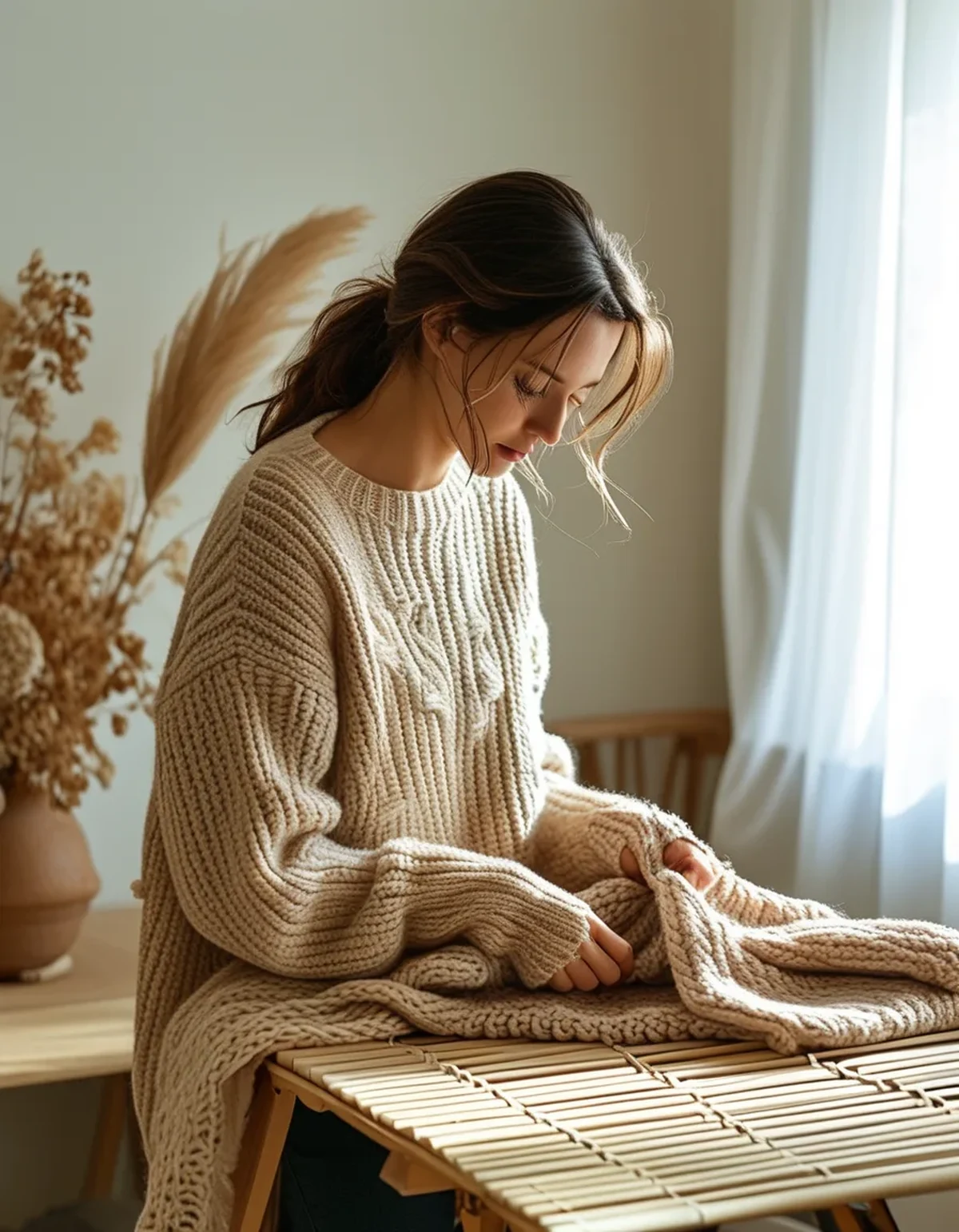
Pin to measurements, not to look nice. Have your target numbers written down and pin the piece to them. This is the step where you get to enforce the size you wanted.
Block ribbing unstretched. Pin the body to width, but leave cuffs and hems relaxed or they will lose their pull-in permanently.
Dry flat, always, for anything drapey. Hanging a wet garment is the most common way to ruin one.
Let it dry completely before moving it. Half-dry fabric is still reformable, and picking it up will undo your work.
Seasonal note: drying takes considerably longer as autumn humidity rises and heating comes on unevenly. Allow two to three days rather than overnight, and use a fan rather than direct heat — direct radiator heat dries unevenly and can felt wool at the contact point.
5 Mistakes Everyone Makes When Blocking
1. Not blocking the swatch. The single most common cause of a finished garment being the wrong size. Everything downstream depends on this.
2. Hanging it to dry. Gravity plus wet fibre equals a sweater that reaches your knees. Flat, always.
3. Blocking ribbing under tension. Stretched-out cuffs and a gaping neckline are almost always this. Ribbing gets to stay relaxed.
4. Steaming acrylic without testing. Killing acrylic is permanent. Test on the swatch, because there is no undo.
5. Assuming one block is forever. Wool garments benefit from re-blocking after washing. If your sweater has grown with wear, a re-block usually brings it back.
FAQ: Blocking Questions, Answered
Do I have to block everything?
Lace and colourwork are transformed by it and effectively require it. Simple stocking stitch in wool benefits noticeably. Acrylic accessories often do not need it.
Can I block a garment smaller?
Somewhat, with wool, by pinning to smaller measurements. You cannot reliably shrink superwash or plant fibres this way.
How long should I soak?
Fifteen to twenty minutes for most fibres. Superwash and plant fibres are fully saturated quickly; wool takes longer than people expect.
Is steam blocking as good as wet blocking?
It is faster and gentler on shape, and it is the right choice for pieces you do not want fully relaxed. Wet blocking gives more dramatic and more permanent results.
What if my sweater grew and I hate it?
For non-superwash wool, re-wet and re-block to the measurements you want. For superwash and cotton, the options are limited, which is why swatching matters most for exactly those yarns.
Why did my cables disappear after blocking?
Over-stretched. Cables pull in by design, and pinning them out flat removes the definition. Block cables to a relaxed width.
TL;DR:
- Blocking resets fibre memory — the shape it dries in is the shape it keeps.
- Superwash, cotton and linen grow and stay grown. Non-superwash wool forgives.
- Block the swatch the same way as the garment and calculate the percentage change before knitting.
- Dry flat, block ribbing relaxed, and never hang a wet piece.
- Killing acrylic with steam is permanent. Test first.
Swatch, block, measure, then cast on. Ten extra minutes saves a whole project.
Keep Reading
This article is for general informational and styling purposes only. Fit, sizing, and product availability may vary.