Why Knitting Calms You Down Some Days and Winds You Up Others
Quick Answer: Knitting calms you when the pattern’s difficulty sits just below your available attention — repetitive enough to occupy your hands and quiet the verbal mind, complex enough that you’re not bored. On days when your attention is already spent, a pattern that was soothing last week becomes irritating, because it now costs more than you have. Match the project to the day, not the day to the project. Keep one mindless project alongside your interesting one.
Same yarn, same chair, same pattern. Tuesday it was meditative. Thursday you wanted to throw it across the room.
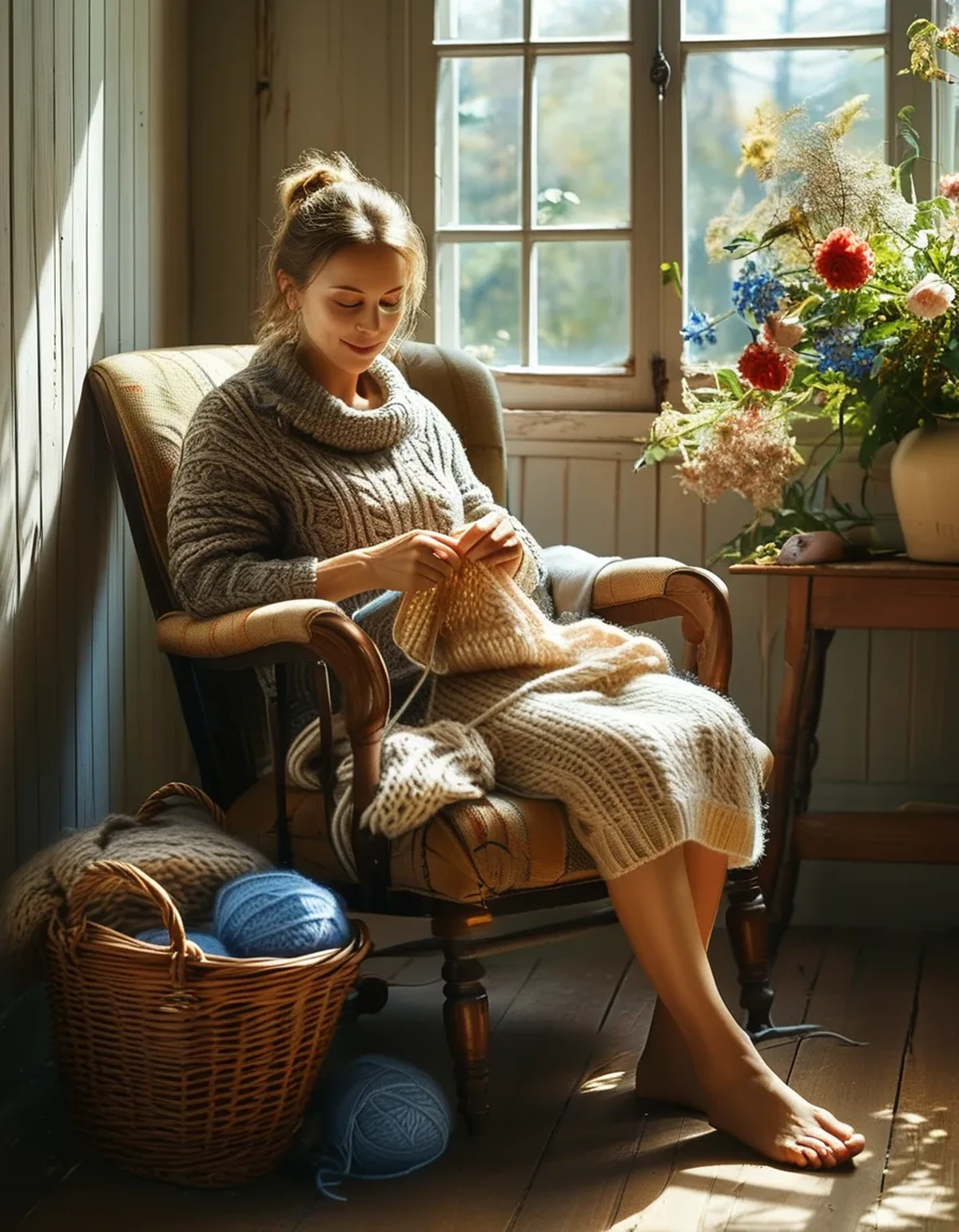
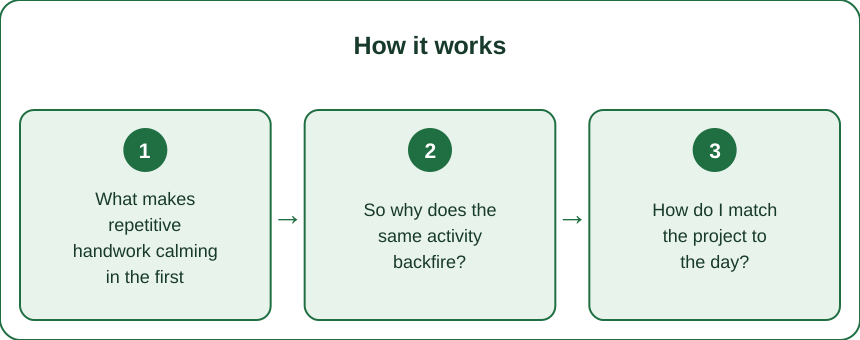
What makes repetitive handwork calming in the first place?
Rhythmic, bilateral, repetitive movement occupies attention in a way that leaves less available for rumination.
The verbal, self-referential mode of thinking — the one that circles worries — needs cognitive resources. Occupy those resources with a sensory-motor task and there’s less left for circling. This is the same reason walking, swimming, and chopping vegetables help.
Repetitive movement also produces predictability, and predictability is regulating for the nervous system. You know exactly what the next second contains, which is the opposite of most anxiety.
There’s a physical component too. The steady rhythm, the slight sway, the warmth of yarn in hands — sensory input that’s consistent and unthreatening.
And there’s visible progress. A row completed is a small, unambiguous accomplishment. On days when nothing else has a clear outcome, that’s not trivial.
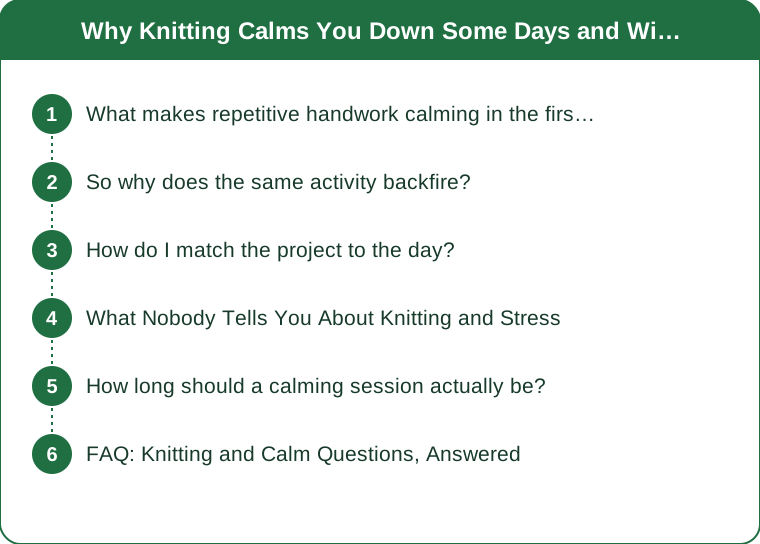
So why does the same activity backfire?
Because the calming effect depends on a match between task demand and available attention — and available attention changes daily.
Think of it as a window. Too easy and your mind wanders straight back to whatever it was circling. Too hard and you’re now managing frustration on top of everything else.
The window moves. After a hard day, your available attention might be a third of what it was on a rested morning. A lace pattern that was absorbing on Sunday is genuinely too demanding on Thursday evening — and the resulting mistakes make it worse.
Frustration compounds fast in handwork because errors are visible and often require undoing. Tinking back six rows at 10pm on a bad day is a reliably terrible experience.
The mistake almost everyone makes is treating knitting as a single activity. It isn’t. Cabled colorwork and a garter stitch scarf are as different, attentionally, as reading a novel and reading a technical manual.
How do I match the project to the day?
Keep at least two projects going, at different difficulty levels. This one change solves most of it.
The mindless project: garter or stockinette, one color, no shaping, no counting. A scarf, a plain hat, a blanket square. This is for depleted days, background TV, conversation, and travel.
The interesting project: whatever’s genuinely engaging — cables, colorwork, lace, shaping. This is for rested mornings and quiet focused evenings.
Pick by checking in honestly before you start. Can you hold a four-row repeat in your head right now? If the answer is uncertain, take the mindless one.
A third category is worth having: the fixing project. Something that needs attention but not creativity — seaming, weaving in ends, blocking. Useful on days when you want to be doing something but can’t take on new decisions.
Physical setup matters too. Good light, supported arms, and a chair that doesn’t round your shoulders. A lot of “knitting made me tense” is actually posture, and it shows up as neck and shoulder tightness within twenty minutes.
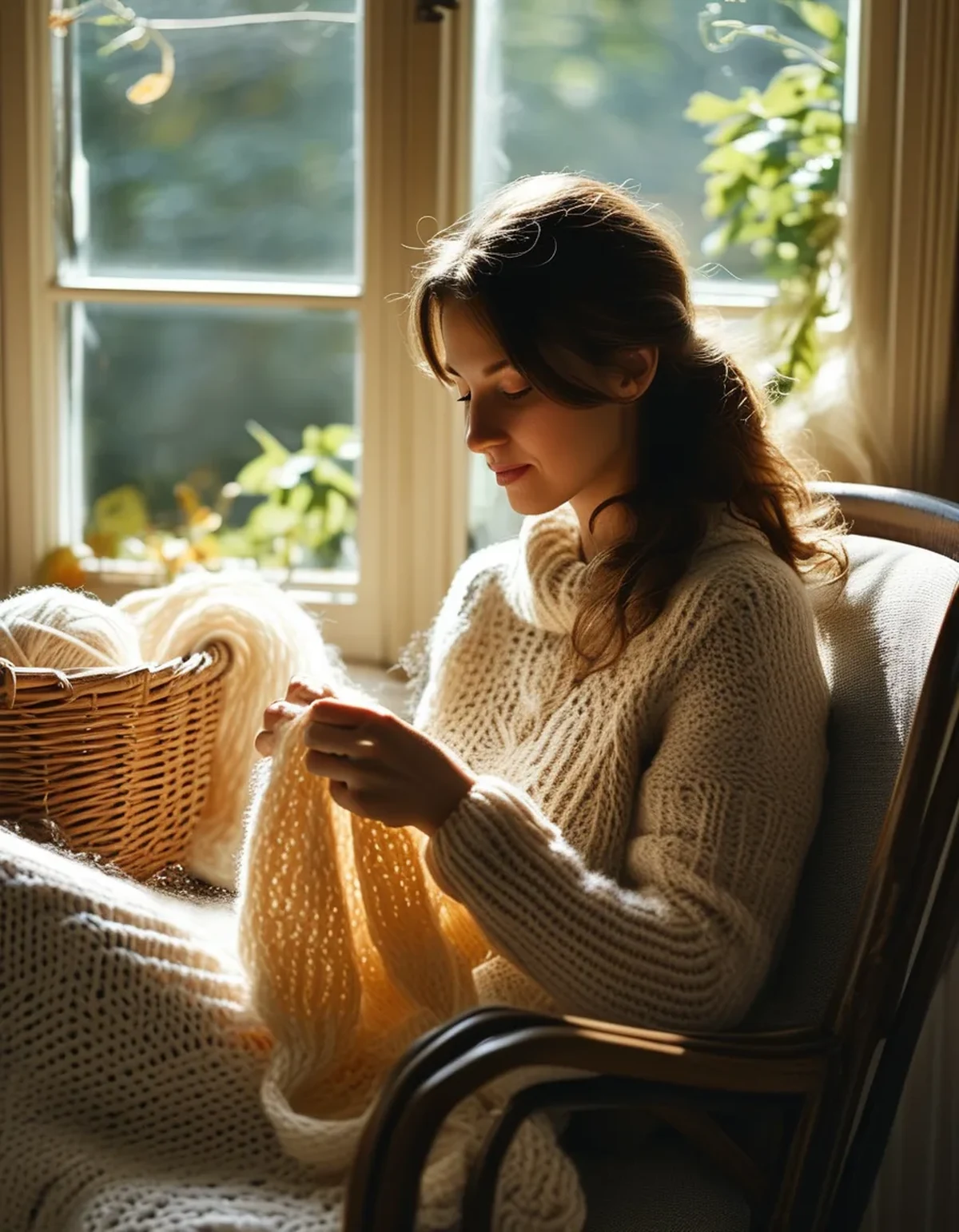
What Nobody Tells You About Knitting and Stress
Deadline knitting is a different activity, and it isn’t calming.
A gift with a date attached converts the entire thing from process to production. The regulation effect comes from the process being open-ended. Once there’s a deadline, every row is measured against remaining time, and that’s just a task with yarn.
This is why holiday knitting is famously stressful despite being the same craft people take up for relaxation. If you’re knitting for calm, be genuinely careful about committing to deadlines.
Project size affects it too. A blanket is soothing for people who like open-ended process and demoralizing for people who need completion. Know which you are — it’s a stable preference and it’s worth designing around.
Yarn matters more than people admit. Splitty yarn, dark colors in poor light, and slippery needles produce continuous low-level friction that undermines the whole point. Cheap yarn on a bad day is a false economy.
Social knitting and solo knitting produce different effects. Solo is where the meditative quality lives. Group knitting is genuinely valuable and it’s a different thing — connection rather than regulation.
And you don’t have to finish anything. A project you no longer enjoy is allowed to be unraveled or abandoned. The number of people carrying guilt about an unfinished sweater is remarkable, and that guilt is the opposite of the reason they started.
How long should a calming session actually be?
Twenty to forty minutes is the sweet spot for most people, and longer isn’t automatically better.
Regulation effects show up fairly quickly — most people feel the shift within ten to fifteen minutes of steady rhythm.
Past about 45 minutes, physical factors start working against you. Hand and forearm fatigue, neck tension from looking down, and eye strain accumulate. The tension you leave with can exceed the tension you arrived with.
Set a soft timer if you tend to lose track. Not to stop you — just to prompt a check-in about your shoulders and hands.
Break every 20 minutes for 30 seconds. Look at something far away, open and close your hands, roll your shoulders. This is the difference between knitting being sustainable and knitting giving you wrist pain in a month.
Watch for actual warning signs: numbness or tingling in the fingers, pain at the base of the thumb, or pain that persists after you stop. Repetitive strain in handwork is real, and it responds well to early adjustment and badly to being pushed through. This is general information, not medical advice.
FAQ: Knitting and Calm Questions, Answered
Is knitting actually meditation?
It shares features with focused-attention meditation — sustained attention on a repetitive sensory anchor. It differs in that meditation trains noticing when attention wanders, while knitting mostly just occupies attention. Both are useful; they aren’t the same thing.
Why do I feel guilty relaxing while knitting but not while reading?
Probably because knitting produces an object, which invites judging the session by output. Reading has no artifact so there’s nothing to measure. If you notice yourself evaluating a session by rows completed, that’s the productivity frame leaking in — and it removes most of the benefit.
Should I knit before bed?
For many people it works well, provided the project is easy and the light is warm. A demanding pattern late at night tends to be activating rather than settling, and the frustration of a mistake at 11pm lingers.
What if I only enjoy hard patterns?
Then use knitting for engagement rather than for regulation, and find something else for depleted days. Not every hobby has to serve every function, and forcing a mindless project on someone who finds it boring just produces a different kind of irritation.
TL;DR: Knitting isn’t calming or agitating — the match between pattern difficulty and your available attention is.
- The calming effect needs a window: absorbing enough to quiet the verbal mind, easy enough not to frustrate.
- That window shrinks on hard days. Sunday’s lace is Thursday’s disaster.
- Keep two projects going — one mindless, one interesting — and choose by honestly checking your attention first.
- Deadline knitting is a different activity and it isn’t relaxing. Be careful what you commit to.
- 20 to 40 minutes, with a 30-second break every 20. Past 45, physical tension starts undoing the benefit.
- Good light and decent yarn remove more friction than any technique change.
A project you’ve stopped enjoying is allowed to be unraveled. That’s not failure — that’s using the hobby for what you took it up for.
Keep Reading
This article is for general informational and styling purposes only. Fit, sizing, and product availability may vary.