Why Knitting Feels Harder When the Room Is Noisy
Quick Answer: Noise makes knitting harder because pattern-following uses working memory, and background speech competes for the same limited resource. Music without lyrics and steady non-speech noise interfere far less than dialogue, podcasts, or conversation. Match the audio to the pattern: talk radio for garter stitch, silence for lace.
You have knit this stitch pattern forty times. It is not hard.
But with a show on you lost count twice, missed a decrease, and had to tink back eleven stitches.
This is not a focus failure or a sign you are getting worse. It is a specific and well-documented interference effect, and once you know the rule you can pick your audio like you pick your needles.

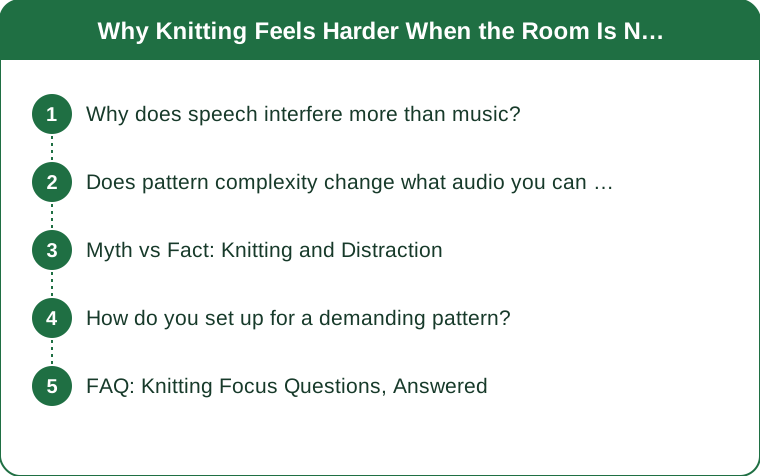
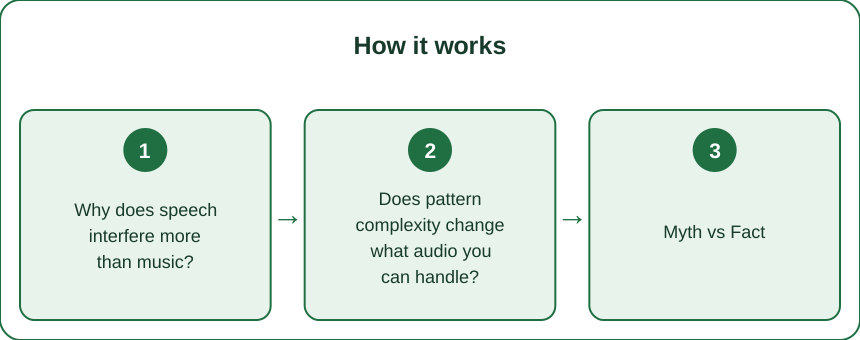
Why does speech interfere more than music?
Because language processing is involuntary. You cannot choose not to parse speech in a language you understand — your brain decodes it automatically, and that decoding runs through the same phonological loop your working memory uses to hold knit two, purl two, slip one.
Instrumental music does not touch that system nearly as much. Neither does steady mechanical noise like a fan or rain.
So the hierarchy for knitting audio looks like this, from least to most disruptive:
- Least: silence, rain, fan noise, ambient instrumental
- Mild: familiar instrumental music, music in a language you do not speak
- Moderate: lyrical music in your language
- Most: podcasts, audiobooks, TV dialogue, someone talking to you
That last category is where the dropped stitches live. It is also, unfairly, the category most of us most want to listen to while knitting.
Does pattern complexity change what audio you can handle?
Enormously, and this is the actionable part. Every pattern has a working memory cost, and your audio budget is what is left over.
Rough matching guide:
- Garter, stockinette, simple ribbing: fully memorized, minimal working memory. Podcasts and conversation are fine. This is TV knitting.
- Cables on a repeating row count: moderate load. Instrumental music works; audiobooks tend to cause missed cable rows.
- Lace, colorwork charts, short rows: high load with position tracking. Silence or ambient noise only.
- First repeat of any new pattern: treat as high load regardless of how simple it looks. Complexity is highest before memorization.
Keep two projects going. One brainless project for social and screen time, one demanding project for quiet mornings. This single habit eliminates most tinking, and it is what nearly every experienced knitter converges on independently.

Myth vs Fact: Knitting and Distraction
Myth: Knitting is meditative, so it should work with anything in the background.
Fact: Knitting becomes meditative once a pattern is automatic. Before that, it is a demanding tracking task that competes directly with language.
Myth: If you keep dropping stitches, you need more practice.
Fact: You may just need a different soundtrack. Test it — knit the same pattern for twenty minutes in silence and twenty minutes with a podcast, and count errors.
Myth: Counting out loud is a beginner crutch.
Fact: Speaking counts aloud occupies the phonological loop on purpose, which blocks external speech from entering it. It is one of the more effective anti-interference tricks available.
Myth: Row counters are for complicated patterns only.
Fact: A physical counter offloads position tracking from working memory entirely, which frees capacity for everything else. Even on simple patterns, it is the cheapest upgrade in the craft.
How do you set up for a demanding pattern?
A five-minute setup that saves an hour of ripping back:
- Pick your window. Whatever time of day your head is clearest — for most people that is morning, before the day loads up.
- Kill speech. Phone face down and on do not disturb. If you need sound, use rain or a fan.
- Externalize the counting. Row counter, sticky note on the chart, stitch markers every repeat. Every count you offload is capacity returned.
- Set a lifeline. Thread waste yarn through a completed row before starting a hard section. It converts a catastrophe into a small annoyance.
- Stop at a marked point, not when you are tired. Note the row number on paper. Resuming mid-repeat from memory is where a surprising number of errors originate.
And if someone starts a conversation mid-lace-row, it is entirely reasonable to hold up a finger and finish the row. Knitters who do this drop fewer stitches and are not, in fact, rude.
FAQ: Knitting Focus Questions, Answered
Why do I make more mistakes at the end of a session?
Working memory degrades with sustained use, and fatigue shows up as position errors first. Sessions of 45 to 60 minutes with a short break work better than one long stretch for complex patterns.
Can I train myself to knit lace with a podcast on?
Partially. As a pattern becomes automatic, its working memory cost drops and audio tolerance rises. But charts with variable rows never fully automate — that is the nature of the task, not a limit of your skill.
Does knitting in a group make me worse?
For anything complex, yes, measurably. That is why knit nights are best paired with simple projects. Bring the sock, leave the shawl at home.
TL;DR:
- Speech competes with pattern-following for the same working memory system; instrumental music does not
- Match audio to pattern complexity: podcasts for garter, silence for lace
- Keep two projects going — one for social knitting, one for quiet focus
- Row counters, stitch markers, and lifelines offload memory and prevent most errors
Try the same complex row in silence tomorrow morning. If your error rate drops sharply, you now know that your knitting was never the problem — your soundtrack was.
Keep Reading
This article is for general informational and styling purposes only. Fit, sizing, and product availability may vary.