Why Knitting in the Round Feels Completely Different From Flat Knitting
Quick Answer: Knitting in the round feels different because you are only ever making knit stitches, never purls, which changes both your gauge and your rhythm. Most knitters produce slightly tighter, more even fabric in the round and lose the row-by-row turning points that flat knitting provides as natural stopping places. The result is a fabric that behaves differently and a session that is meditatively smooth but far harder to put down.
You switch a familiar pattern from flat to circular, and somewhere around the third round you realise you have been knitting for fifty minutes and have not looked up once.
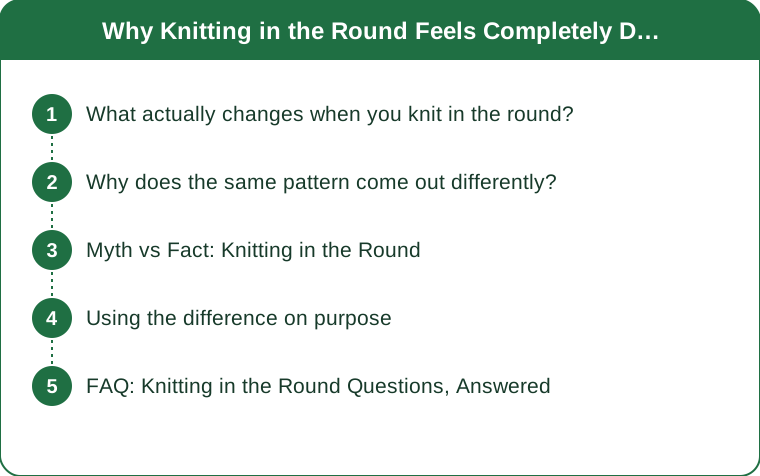
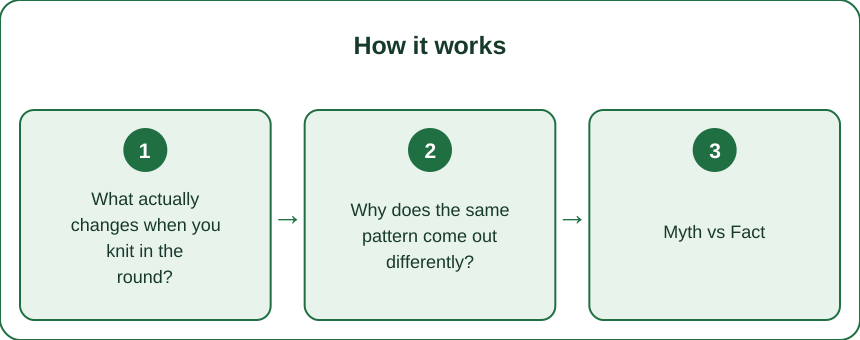
What actually changes when you knit in the round?
More than the shape of the finished piece.
You stop purling entirely. Stockinette in the round is knit stitches on every round. Worked flat, it alternates knit and purl rows. For most knitters those two stitches are not produced at identical tension.
Purl stitches are usually slightly looser. The purl motion requires the yarn to travel a marginally longer path, and most people work them with less consistent tension than knits. Flat stockinette therefore contains a subtle alternating rhythm that round knitting does not.
Row gauge shifts more than stitch gauge. Because the loose purl rows disappear, fabric worked in the round is frequently a little denser vertically. This is exactly why a pattern written flat can come out short when worked in the round at the same gauge.
Rowing out disappears. Those faint horizontal stripes in flat stockinette come from the knit-purl tension difference. In the round they simply cannot occur, which is why circular stockinette so often looks more professional.
There are no turns. No stopping to flip the work every row. The fabric moves continuously in one direction, and this is the source of both the meditative quality and the difficulty stopping.
And the right side always faces you. You are watching the public side of the fabric develop the entire time, which makes mistakes far easier to spot and colourwork substantially easier to read.
Why does the same pattern come out differently?
Because the gauge swatch you made probably lied to you, through no fault of its own.
A flat swatch does not predict circular gauge. If you swatched flat and are knitting in the round, you swatched a different fabric. The standard advice is to swatch in the round for circular projects, either on a small circumference or using the speed-swatch method of knitting across and carrying the yarn loosely behind.
Most knitters go tighter in the round. Not everyone, but it is the common direction. A half-stitch per inch difference over a 40 inch sweater body is 20 stitches, which is a full size.
Row gauge differences catch people out on yokes. Yoke depth is calculated in rows. If your row gauge is denser than the pattern assumed, the yoke arrives short and the sweater fits oddly around the underarm even though the stitch count is correct.
Ladders appear at needle joins. With double-pointed needles or magic loop, the stitch spanning the join is often looser. Working the first two stitches after each join a little more firmly, and shifting the join position every few rounds, resolves it.
Ribbing behaves differently too. In the round, ribbing is worked as consistent columns rather than alternating rows, which usually produces a neater but slightly less elastic result.
The practical rule: if the pattern is written for the round, swatch in the round. If you are converting a flat pattern, expect to adjust either needle size or row counts, and check the fabric against the pattern’s stated gauge before committing to a whole sleeve.
Myth vs Fact: Knitting in the Round
Myth: Knitting in the round is harder than flat knitting. Fact: Once the cast-on is joined, it is generally easier - only knit stitches, no turning, the right side always visible. The difficult part is concentrated entirely in the first round, which is why it feels harder to beginners.
Myth: Your gauge will be the same as your flat gauge. Fact: For most knitters it is not, because the loose purl rows disappear. Tighter fabric in the round is the usual direction, and over a sweater body that difference can amount to a full size.
Myth: You need double-pointed needles for small circumferences. Fact: Magic loop and the two-circulars method both handle sleeves and socks perfectly well, and many knitters find them faster and less prone to ladders than double-points.
Myth: Circular needles are only for knitting in the round. Fact: They work perfectly for flat knitting and many knitters prefer them for it, since the weight of the project rests in your lap rather than hanging off the needle tips. This is a genuine ergonomic advantage on large pieces.
Myth: A twisted join can be fixed later. Fact: It cannot. If the cast-on twists around the needle when you join, the resulting mobius is unrecoverable and the only fix is to rip back to the join. Checking carefully before joining is the single highest-value 20 seconds in circular knitting.
Myth: Steeking is terrifying and only for experts. Fact: Cutting a knitted fabric feels alarming and is remarkably secure when done with a reinforced steek in wool that grips itself. It exists precisely so colourwork can be worked in the round and opened later - a practical solution rather than an advanced flourish.
Using the difference on purpose
Once you know how the two behave, you can choose deliberately.
Choose the round for anything with colourwork. Stranded knitting in the round means you never purl with two colours, which is the part that ruins most people’s tension. This alone is why traditional colourwork sweaters were worked in the round and cut open afterwards.
Choose the round for smooth stockinette. No rowing out, no visible tension alternation, and a more even fabric with less effort.
Choose flat for heavily textured or cabled work. Reading a cable chart worked flat is more familiar to most knitters, and the alternating rows suit some texture patterns better.
Use the round for calm and flat for focus. This is the practical difference most knitters actually notice. Round knitting removes decision points and becomes genuinely meditative. Flat knitting gives you a natural pause every row, which is useful when you are knitting alongside a conversation or a film.
Set artificial stopping points in the round. Since the fabric never tells you to stop, use a row counter and decide in advance - five rounds, then a break. Circular projects are the classic cause of an hour disappearing and a stiff neck arriving.
Place your join at a seam-equivalent line. Beginning of round marks tend to be slightly visible. Putting them at the underarm or the side means any small irregularity lands where nobody looks.
And keep the marker moving on rounds where you increase at the join. A marker that gets knitted into the fabric is a small tragedy that repeats itself surprisingly often.
FAQ: Knitting in the Round Questions, Answered
Is my gauge different in the round than flat?
Usually yes. Round knitting eliminates purl rows, which are typically looser, so most knitters produce slightly tighter fabric. Swatch in the round for circular projects rather than relying on a flat swatch.
Why does my knitting have loose columns of stitches?
Those are ladders at the needle joins, where the stitch spanning the gap gets extra yarn. Work the first two stitches after each join more firmly and shift the join position every few rounds.
Can I convert a flat pattern to knit in the round?
Often yes, but expect to adjust. Row gauge in particular tends to be denser in the round, which affects anything calculated in rows such as yoke depth. Swatch first and recalculate rather than trusting the written numbers.
Why does knitting in the round feel more relaxing?
Because you make the same stitch continuously with no turning and no decision points. That uninterrupted repetition is what produces the meditative quality, and it is also why it is unusually hard to stop.
What do I do if my cast-on is twisted after joining?
Rip back and rejoin. A twist cannot be corrected later, and the result is a mobius rather than a tube. Spreading the stitches flat and checking the cast-on edge before joining prevents it.
TL;DR:
- In the round you only knit, never purl, which changes both your gauge and the fabric’s appearance.
- Most knitters go tighter in the round, and row gauge shifts more than stitch gauge.
- Rowing out disappears entirely, which is why circular stockinette looks so even.
- Swatch in the round for circular projects - a flat swatch predicts a different fabric.
- Set deliberate stopping points, because the work never gives you one.
Same stitch, different rhythm. Flat knitting punctuates itself every row; circular knitting will happily let you knit until midnight.
Keep Reading
This article is for general informational and styling purposes only. Fit, sizing, and product availability may vary.