Why the Second Sleeve Knits Faster - and Ends Up a Different Size
Quick Answer: The second sleeve is faster because you have already solved the pattern - no chart checking, no counting from scratch, no hesitation. And that speed is exactly why it comes out different. Faster knitting is nearly always tighter knitting, because familiarity increases yarn tension at the fingers and reduces the small pauses where your hands would otherwise relax. A second sleeve one to two centimetres narrower than the first is a completely ordinary outcome.
The fix is not to knit slower. It is to knit both sleeves in the same conditions, and there are three practical ways to do that.
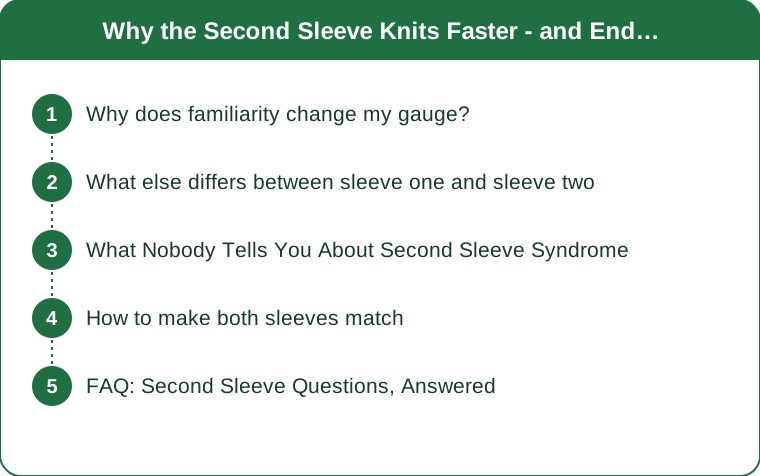
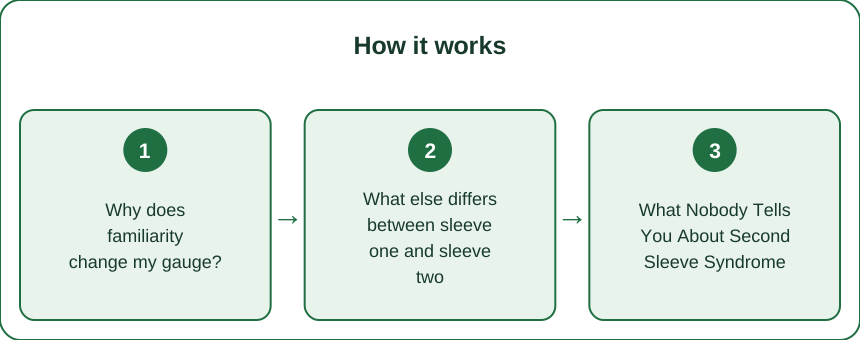
Why does familiarity change my gauge?
Because gauge is produced by your hands, and your hands behave differently when they are not thinking.
Hesitation creates slack. On the first sleeve you stop to check the chart, recount a decrease row, and reread the instruction. Every one of those pauses is a moment where your hands relax and the working yarn loosens fractionally. Dozens of small releases per row add up to a measurably looser fabric.
Confidence creates grip. On the second sleeve you know exactly what comes next, and the yarn runs through your fingers under steadier, higher tension. Nothing interrupts it. The fabric that results is denser and narrower.
Rhythm compounds it. Continuous knitting builds a rhythm, and rhythm tends toward efficiency, and efficiency in knitting means shorter yarn paths and tighter loops.
And the yarn itself has changed. The ball you started with was full and heavy; the ball on the second sleeve may be smaller, lighter, and pulling differently off the shelf or out of the bag. Yarn fed from a nearly empty centre-pull ball behaves differently than yarn from a full one.
The size of the effect: half a stitch per inch is common and sounds trivial. Over a 40-stitch sleeve that is a full centimetre, and over a sleeve length it compounds into a visibly different garment.
What else differs between sleeve one and sleeve two
Tension is the biggest variable, but it is not alone. Anything that differs between the two sessions can show up in the fabric.
Time of day. Evening knitting is looser than morning knitting for most people - hands are more tired and grip is weaker. If sleeve one was a relaxed Sunday afternoon and sleeve two was three tense evenings after work, you have two different fabrics.
Needles. Using a different pair of the same nominal size is a well-known trap. Metal and wood at the same stated size produce different gauge because friction differs, and even two metal needles from different brands vary slightly in actual diameter.
Mood and stress. This sounds soft and it is measurable. Stress increases grip force, and knitters routinely find their gauge tightens in stressful periods. If you knit the second sleeve during a difficult week, it will show.
Position. Knitting in an armchair with the work resting on your lap is different from knitting upright at a table or in a car. Arm position changes how much the working yarn is pulled between fingers and needle.
Dye lot. Not tension at all, but it belongs on the list because it produces the same complaint - two sleeves that do not match - and it is invisible until the garment is assembled under good light.

What Nobody Tells You About Second Sleeve Syndrome
The standard advice is to knit both sleeves at once, and it is good advice that most people ignore. Here is what is less often said.
The problem is almost never boredom. Knitters describe it as motivation, but the reluctance is often anticipation of the mismatch - some part of you already knows the second one will not match, and that is a genuinely demoralising thing to start.
Blocking hides less than people hope. Blocking can even out a lot of small irregularities, but it cannot add fabric that was never knitted. A sleeve with fewer, tighter stitches per centimetre will block to a slightly larger size and then relax back toward its knitted dimension, particularly in wool.
The sleeve is the worst place for this to happen. Body pieces are wide, so a half-stitch difference distributes over many stitches and is easy to miss. A sleeve is narrow and worn on a limb people look at, and the difference in cuff circumference is the most visible mismatch in the whole garment.
And the second sleeve is often the better one. More consistent, tidier decreases, cleaner joins. The mismatch is not sloppiness - it is improvement, which is a genuinely nicer way to think about it while you decide what to do.
The oldest fix is still the best one: knit both at the same time. Every alternative on the list below is a workaround for not having done that.
How to make both sleeves match
Ranked from most reliable to most convenient, and any one of them beats hoping.
1. Knit both at once - two circulars or magic loop. Every row is worked on both sleeves in the same session, with the same hands, the same mood, and the same needles. This eliminates the problem rather than managing it. The setup takes 15 minutes and feels fiddly for the first two rows and then stops being an issue.
2. Alternate in blocks. If working both simultaneously does not suit you, swap every 10 rows. You keep the flow of single-sleeve knitting and still average out session-to-session variation.
3. Knit them back to back. Start sleeve two the same day you finish sleeve one, at the same time of day, in the same chair, with the same needles. Not perfect, considerably better than a three-week gap.
4. Measure as you go, not at the end. Check width every 5 centimetres against the first sleeve and compare on a flat surface, unstretched. Catching a discrepancy at 8 centimetres costs you an hour; catching it at the cuff costs you the sleeve.
The habits that support all four:
- Note your needles. Brand, material, size, written in the pattern margin
- Note where you were and when. Sounds excessive until the third time it saves you
- Keep sleeve one visible while knitting sleeve two, on the table beside you. The comparison happens automatically
- Do not reknit for a half-stitch. If the difference is under a centimetre after blocking, it is inside the range nobody will ever notice on a moving arm
And if the difference is genuinely large, reknit the second sleeve rather than the first. You are better at it now.
FAQ: Second Sleeve Questions, Answered
Can blocking fix a sleeve that came out too tight?
Partially, and only in fibres that respond - wool and alpaca will stretch and hold a fair amount; cotton and acrylic will not hold it at all. Even in wool, aggressive blocking to force a match usually relaxes back after a few wears.
Should I go up a needle size on the second sleeve?
Only if you have measured a real difference over at least 10 centimetres of knitting. Changing needle size preemptively usually overcorrects, and then you have the same problem in the opposite direction.
Does this happen with socks too?
Constantly, and it is the same mechanism. Two-at-a-time socks exist for exactly this reason, and sock knitters adopted the technique long before sweater knitters did.
My second sleeve is looser, not tighter. Why?
Usually fatigue or a long gap - if the second sleeve was knitted while tired, unwell, or after months away from the project, grip force drops and gauge opens up. The direction reverses; the cause is the same category.
TL;DR:
- The second sleeve is faster because you stopped hesitating, and hesitation was creating slack
- Confident continuous knitting runs at higher tension, so sleeve two comes out narrower
- Needles, time of day, stress, and seating position all shift gauge between sessions
- Two-at-a-time knitting eliminates the problem; alternating in 10-row blocks nearly does
- Measure against sleeve one every 5cm rather than discovering it at the cuff
Before you cast on the next pair of sleeves, spend fifteen minutes setting them up two-at-a-time. It is the only version of this problem that never comes back.
Keep Reading
This article is for general informational and styling purposes only. Fit, sizing, and product availability may vary.