Why Your Knitting Tension Changes Mid-Project (and How to Fix It)
Quick Answer: Tension usually drifts because hand fatigue, distraction, or a shift in how you’re holding the yarn changes partway through a long project. Taking short breaks every 20-30 minutes and periodically checking your grip against how you started keeps tension consistent.
You start a project with perfectly even stitches, and somewhere around row 40 things start looking a little different — here’s what’s actually happening.

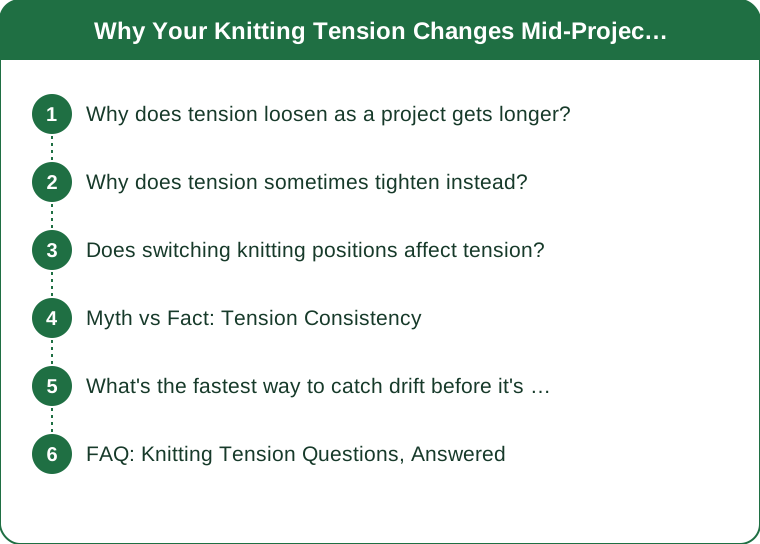
Why does tension loosen as a project gets longer?
As hands fatigue over an hour or more of repetitive motion, grip pressure on the working yarn subtly decreases without you noticing, producing looser, larger stitches later in a project compared to the tighter start.
Why does tension sometimes tighten instead?
Stress, distraction, or watching TV while knitting can cause an unconscious tightening grip, especially during tense scenes or focused conversation — the opposite fatigue effect, but just as disruptive to even gauge.
Does switching knitting positions affect tension?
Yes — knitting on a couch with yarn draped differently than at a table with it in your lap changes the tension path the yarn travels before reaching your fingers, subtly shifting how much resistance you’re applying.

Myth vs Fact: Tension Consistency
Myth: experienced knitters never have tension drift. Fact: even advanced knitters drift over long sessions — the difference is they check and self-correct every 20-30 minutes rather than knitting an entire sweater in one sitting without a gauge check.
What’s the fastest way to catch drift before it’s a problem?
Laying a completed section flat every 20-30 minutes and comparing stitch size to the first few rows catches drift early, while it’s still a few stitches — much easier to blend out than after several inches of gradually shifting gauge.
FAQ: Knitting Tension Questions, Answered
Can blocking fix uneven tension after the fact?
Blocking evens out mild tension variation reasonably well for many fibers, especially wool, but it won’t fully correct dramatic gauge shifts, so catching drift early is still the better fix.
Does needle material affect tension consistency?
Slippery materials like metal or bamboo affect how yarn glides differently than wood, and switching needle types mid-project without adjusting grip is a common overlooked cause of a sudden tension shift.
Should beginners worry about this on their first project?
Not excessively — tension consistency improves naturally with practice, and a first project with mild variation is a normal learning step, not a failure.
TL;DR:
- Hand fatigue usually loosens tension; stress or distraction usually tightens it
- Body position and needle material both subtly affect grip and yarn path
- Checking gauge every 20-30 minutes catches drift while it’s still easy to fix
- Blocking helps smooth minor variation but isn’t a substitute for consistent tension habits
Even tension is a trainable habit, not a fixed talent, and it gets easier with a bit of regular checking.
Keep Reading
This article is for general informational and styling purposes only. Fit, sizing, and product availability may vary.